Dear Reader and Friend,
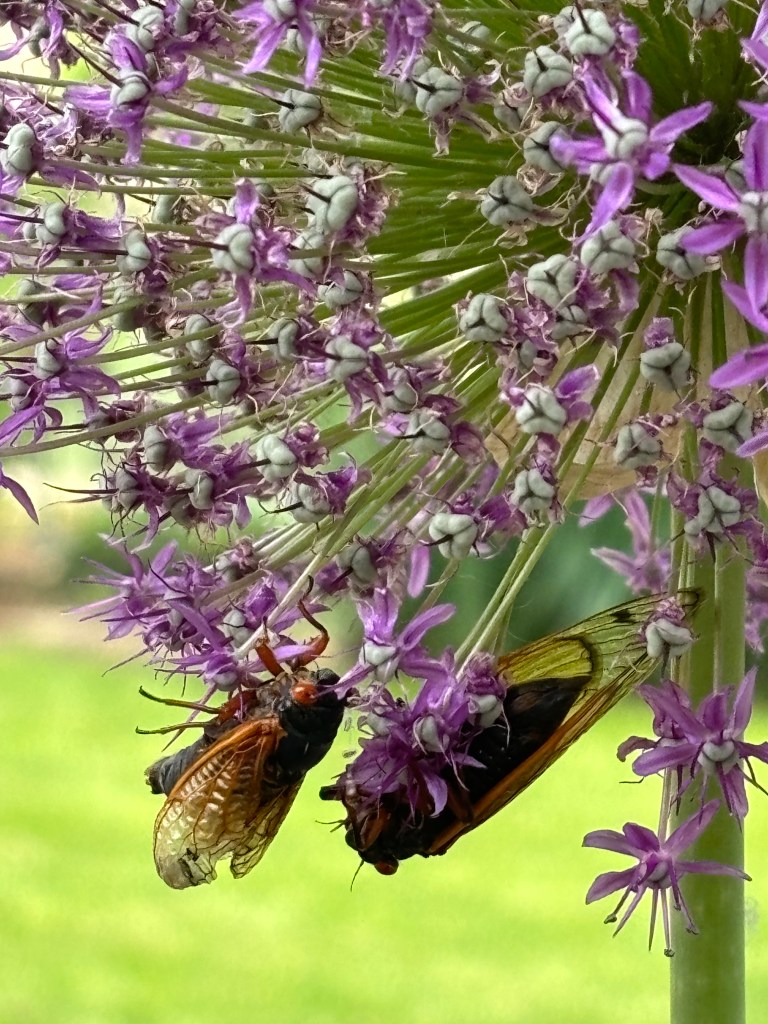
The calendar declared spring and I was ambitious. Two weeks after the equinox, I readied my backyard patio here in a near west suburb of Chicago as if it were summer. From my neighbor’s trees, mulberries would fall onto the patio and make a mess by the second week of June. And for the first time since the year 1803, the co-emergence of the thirteen-year and seventeen-year periodical cicadas would start sometime in May.
Though the bricks chilled my bare feet that April morning, and the prediction of overnight frost was sure to continue into early May, I pulled out the hose from the garage, attached it to the hose bib on the back of the house, and began spraying winter off the furniture, empty flowerpots, the corners of the patio where collections of dried autumn leaves laid in clumps. I knew I should have paused to move the Mother Mary statue before the hose snaked along Her feet and knocked her over, leaving her lying prostrate on the ground. When I lifted Her up, she was handless. Her broken hands cupped weeds sprouting from a brick joint, and I left them as is.
Full confession: I wasn’t disappointed She broke because I’ve been on the fence about if I like this image of Mary. I bought Her five years ago at a garden nursery shortly after my mother died. Her deep brown eyes reminded me of my mother’s. Her painted peach lips offset the ash-colored stone. I wasn’t crazy about the perfect bow draped at her waste. But I was attracted to the wind and fire etchings at her toes.
When I brought Her home, I placed her on a high shelf in my study next to a handful of Blessed Mother statues my mother gave me when she didn’t want them anymore. The Our Lady of the Streets, her favorite image of the Blessed Mother. The porcelain-like Mary with a tiny flower planter behind her heels, a gift someone gave my mother for her birthday. The Mother of Mothers Shrine statue she received from the parish priest after her beautiful baby boy died at two days old on Christmas Day before I was born.
It wasn’t long until the wind and fire Mary tied with a bow seemed out of place next to the others. She looked more like a religious mold than a unique and generous woman. Her tinted lips appeared unnatural. Her eyes looked more like a plastic doll’s. Her skin tone looked closer to death than to vitality. When I rearranged my study last November, I decided the wind and fire Mary corseted with a bow was an impulsive buy in a moment of missing my mother. I moved the statue outside to a haphazard spot on the patio. I wasn’t sure I wanted to keep her, yet I didn’t want to hand Her off to my daughter or a friend or dump Her in the trash or drop Her off at a donation center.
Did my mother hand her Catholic goods off to me because she felt guilty discarding religious materialism? Was I feeling guilty? Is guilt somehow blanketed in the cradle while two silent hands work to feed and bathe and clothe and comfort and hold a newborn? Whose hands are there for us when life unravels, and we crave to live anew? When we wish our grief would vanish? When we ache to live in harmony? When we are disgraced while trying to be grace?
I had one chilly month to enjoy reading and eating on the patio before the first of the cicada nymphs appeared from out of the earth and climbed up aged trees and backyard fences like an explosive swarm of yellowjackets. The communal anticipation, fascination, and the greatest of feelings about their arrival, anxiety, was prevalent. A landscape company halted new summer hires due to the cicada invasion. A local restaurant got crafty and offered a cocktail with a cicada made from black straws and maraschino cherries hanging from the rim of the glass. As for the mulberries, they clung to the tree branches with glee. Though they would eventually fall in bushels, they knew the mourning doves, cardinals, robins, squirrels, and dogs were waiting to feast on the trillion tasty cicadas.
The weeds have grown into a garden around the broken hands of the fire and wind Mary bound with a bow. I glance at them every few days. They remind me of many memorable hands. The osteopathic hands of my father that never held my children because he died before they were born. The generous hands of the stranger that picked up the splayed deck of cards my toddler son dropped while we hurried to cross the street. The loyal hands of my deceased brother that dialed his work phone to call me in the middle of the day just to say hello. The sixteen angelic hands of mother’s caregivers that helped me care for her during her years living with Alzheimer’s as if my mother was their own. The immigrant hands of my grandmother that held my young face with affection as she spoke in her southern Italian dialect I didn’t understand. The empathetic hands of the friend that held mine together when he told me to stay refulgent during family discord. The Beloved hands of the minister that, on the corner of Peoria and Monroe Streets in Chicago, marked my forehead with Lenten ashes. The quiet hands of the three women and man that plucked pounds and pounds and pounds of cicadas from blades of grass and the bark of trees in my local park for food because where they live forty minutes away, there was no emergence of cicadas.
My patio is now covered and stained with fallen June mulberries. The exceptional visit from the cicadas has dwindled down to a leftover wing here, an early evening chirp there, and a collection of scattered exuviae and cicadas laying still as stones. Believe it or not, I might miss them.
The daily creek and screech and rain stick rhythms of these googly-eyed and iridescent-winged insects was unprecedented. For over thirty days, they were a bounty of life. Some days, the rising decibel of their liberated buzz gave me a headache. Other days, I found my brown eyes staring into the bulging red eyes of the solo traveler as I tried to figure out her click. Many days, a cicada flew onto my ankle, my rib, my neck, my hair, my eyebrow, my heart, and to my surprise, found her way to my bedroom carpet, to the edge of the garbage disposal, to the dashboard of my car, and to cling to the back of a woman walking in front of me into the bookstore.
I can’t pay back those who offered me love through the work of their hands, broken or not. But the feeling of abundance I experienced from the example of their unscripted little ways motivates me to pay it forward whenever an opportunity presents itself.
With a calm that surprised even me, I spoke to the woman walking into the bookstore.
Um, you have a cicada on your back and if you just hold still, I’ll take it off you.
Neither of us jumped to the ceiling with panic. Neither one of us flailed our arms with fear. Another woman walking in at the same time, first checked to make sure she didn’t have a cicada on her, then stood with us to observe.
I placed my left hand on the woman’s shoulder. With my right forefinger and thumb, I secured the cicada’s fragile wings. Slowly, I pulled until his sticky legs let go of the back of her maroon sweat jacket. While the woman shook off the cicada jitters, and talked with the other woman about how these insects seemed to have moved in with us, I opened the double doors of the bookstore, let go of his wings, and watched the cicada fly with an alluring zip into the cloudless blue sky.
Until I write to you again, I wish you a moment of beauty through the offering of selfless hands that will last your lifetime.
Marie
 The Birch Chronicle
You must be logged in to post a comment.